American Holocaust: The Conquest of the New World by David E. Stannardx
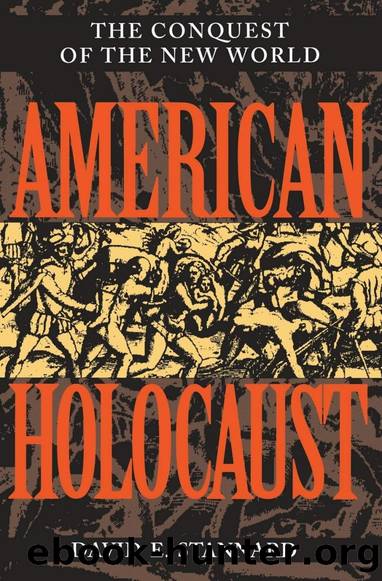
Author:David E. Stannardx [Stannardx, David E.]
Language: eng
Format: epub
Publisher: Oxford University Press
Published: 1992-01-01T06:00:00+00:00
And still it was not over. From Mainz the killing spread to Trier. From there it moved on to Metz, and then to Cologne, and then to Regensburg, and then to Prague. By the time the killing stopped little more than a month was gone since it had begun in the town of Speyer, and as many as eight thousand Jews lay dead.88
It was not coincidence that the massacres of May and June 1096 occurred at the same time that the First Crusade of Pope Urban II was just getting under way. For the mass murderers of the Jews in Speyer and Worms and Mainz and Metz and Cologne and Regensburg and Prague were errant bands of Christian soldiers who had wandered from the overlong trail to Jerusalem, under the leadership of such perfervid souls as Peter the Hermit and Count Emicho of Leiningen, to search out and destroy heretical victims who were closer to home than were the Saracens of the Holy Land. Those Crusaders who fulfilled the charge to march all the way to Jerusalem, however, were no less faithful to the impulse of Christian blood lust.
The very earliest Christian leaders had been of differing minds on the matter of warfare in general, having themselves suffered from military oppression under Roman rule. Thus, the influential Church father Origen was outspokenly opposed to war, while other Christians were members of Marcus Aureliusâ âthundering legionâ; similarly, the New Testament contains passages that have been interpreted as supporting any number of positions on the matter, from pacifism to warlike zealotry.89 The Old Testament, however, is unremitting: âAnd when the Lord thy God shall deliver [thy enemies] before thee,â says Deuteronomy 7:2, 16, âthough shalt smite them, and utterly destroy them; thou shalt make no covenant with them, nor shew mercy unto them⦠. Thou shalt consume all the people which the Lord thy God shall deliver thee; thine eye shall have no pity upon them.â And later, in Deuteronomy 20:16â17 (the passage noted earlier that was cited so gleefully by Puritan John Mason as justification for the extermination of Indians): âOf the cities ⦠which the Lord thy God doth give thee for an inheritance, thou shalt save alive nothing that breath-eth⦠. But thou shalt utterly destroy them.â This was âwar commanded by God,â writes James Turner Johnson, âa form of holy war. In such war not only was God conceived as commanding the conflict, but he was understood to be directly involved in the fighting, warring with the divinities of the enemy on the cosmic level even as the soldiers of Israel dealt with their human counterparts on the earthly level.â90
When Augustine came to pronounce on these matters he uttered some words warning of excess in the violence one was properly to bring to bear on oneâs enemies, but his overall pronouncements were strongly in support of divinely inspired wrack and ruin. As Frederick H. Russell summarizes Augustineâs views:
Any violations of Godâs laws, and by easy extension, any violation of Christian doctrine, could be seen as an injustice warranting unlimited violent punishment.
Download
This site does not store any files on its server. We only index and link to content provided by other sites. Please contact the content providers to delete copyright contents if any and email us, we'll remove relevant links or contents immediately.
| Anthropology | Archaeology |
| Philosophy | Politics & Government |
| Social Sciences | Sociology |
| Women's Studies |
Cecilia; Or, Memoirs of an Heiress — Volume 1 by Fanny Burney(32562)
The Great Music City by Andrea Baker(32023)
Cecilia; Or, Memoirs of an Heiress — Volume 2 by Fanny Burney(31959)
Cecilia; Or, Memoirs of an Heiress — Volume 3 by Fanny Burney(31945)
We're Going to Need More Wine by Gabrielle Union(19053)
All the Missing Girls by Megan Miranda(16050)
Pimp by Iceberg Slim(14522)
For the Love of Europe by Rick Steves(14174)
Bombshells: Glamour Girls of a Lifetime by Sullivan Steve(14081)
Norse Mythology by Gaiman Neil(13376)
Talking to Strangers by Malcolm Gladwell(13376)
Fifty Shades Freed by E L James(13247)
Mindhunter: Inside the FBI's Elite Serial Crime Unit by John E. Douglas & Mark Olshaker(9348)
Crazy Rich Asians by Kevin Kwan(9297)
The Lost Art of Listening by Michael P. Nichols(7509)
Enlightenment Now: The Case for Reason, Science, Humanism, and Progress by Steven Pinker(7316)
The Four Agreements by Don Miguel Ruiz(6770)
Bad Blood by John Carreyrou(6626)
Weapons of Math Destruction by Cathy O'Neil(6284)
